Why Does My Basement Smell Musty Even When It Looks Dry?
If you keep asking why does my basement smell musty even when it looks dry or why a basement smells musty but looks dry or why a basement smells musty but looks dry, you are dealing with one of the most misleading home moisture patterns there is. The room does not have standing water. The floor may feel solid. The walls may not show obvious staining. There is no active drip in sight. And yet the basement still smells stale, damp, or slightly earthy in a way that tells you something is off.
That smell matters because moisture problems often appear in the air and in stored materials before they show up as visible wetness. A basement can feel and smell damp long before it looks wet. That is especially true in cooler spaces where airflow is weak, surfaces dry slowly, and humidity stays trapped in corners, behind storage, or near outside-facing walls.
The key is understanding that a dry-looking basement is not always a dry basement. It may simply be holding moisture in less obvious ways. In practice, a basement smells musty but looks dry when hidden moisture is affecting the air, materials, or cooler surfaces before obvious wetness appears. In practice, a basement smells musty but looks dry when hidden moisture is affecting the air, materials, or cooler surfaces before obvious wetness appears.
Why a basement smells musty but looks dry
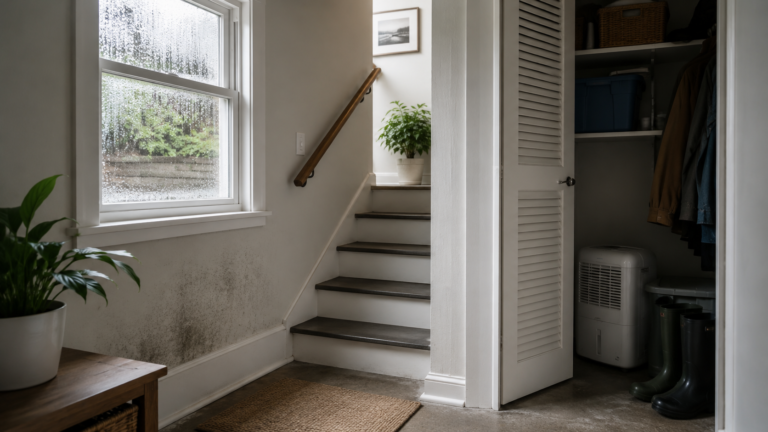
A musty smell does not need visible water to exist. In many basements, the smell comes from repeated low-level dampness rather than dramatic leaking. Moisture may be in the air, inside materials, on colder surfaces, or trapped in areas the eye does not immediately register as wet.
Basements are especially prone to this because they are usually cooler and less ventilated than the rest of the house. Even when the floor looks fine and the walls are not visibly dripping, the environment can still support stale odor if it stays just damp enough, just often enough.
That is why smell is often one of the first useful clues. The room is telling you the moisture balance is off before visible dampness becomes easier to spot. This is also why a musty basement but dry-looking surfaces can still point to a real moisture pattern worth checking. This is also why a musty basement but dry-looking surfaces can still point to a real moisture pattern worth checking.
The most common hidden reasons
Hidden Cause Blocks
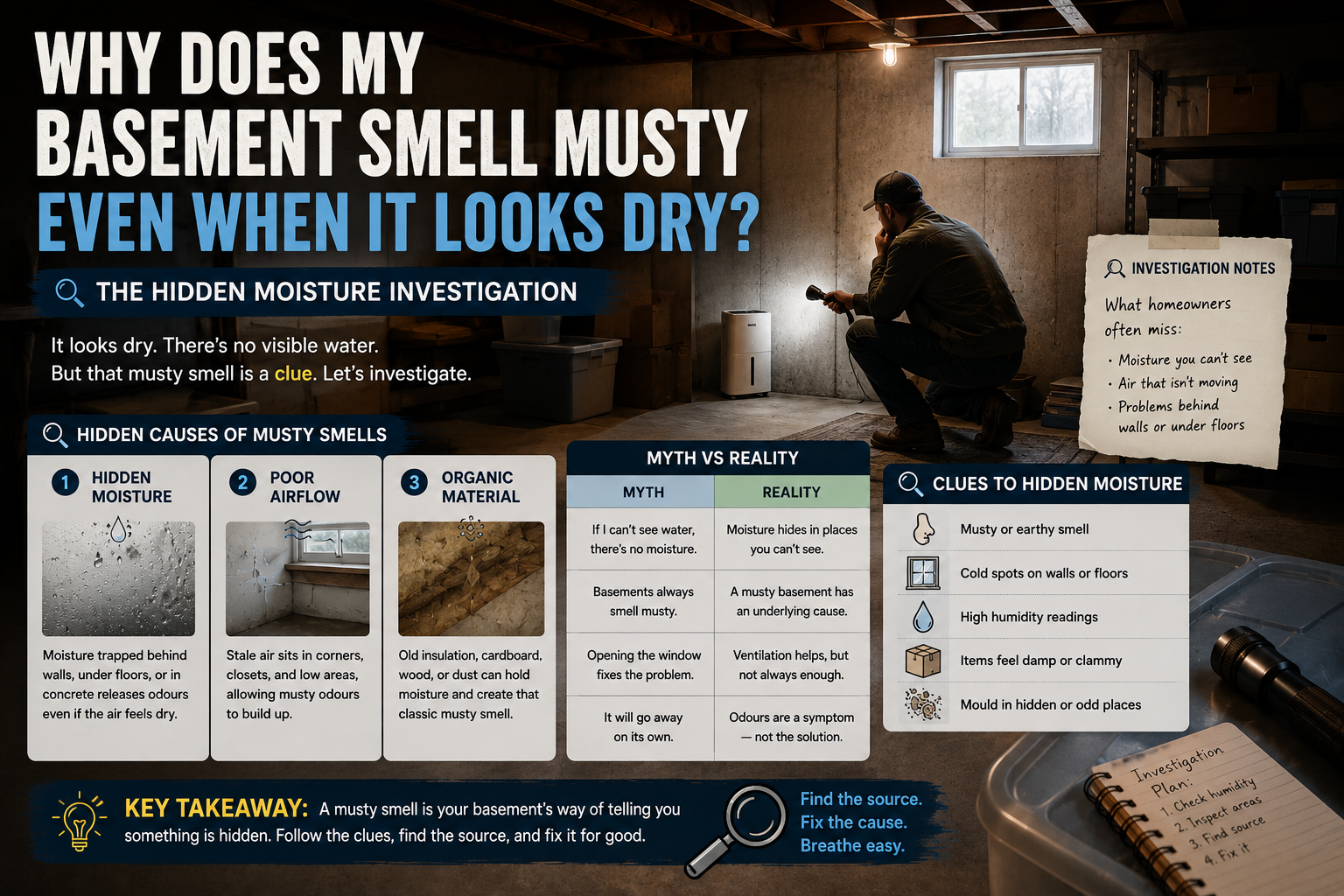
🔍 Hidden Cause #1 -> humidity in the air that never becomes a puddle
🔍 Hidden Cause #2 -> cool surfaces that keep condensing lightly
🔍 Hidden Cause #3 -> storage materials absorbing odor before the room looks wet
Humidity in the air
One of the most common explanations is simply that the basement air is too humid. A room can look dry and still feel wrong because excess moisture is hanging in the air, not pooling on surfaces. This often creates that heavy, stale, slightly damp feeling people notice most on warm or rainy days. A basement that smells musty but looks dry is often really a basement with a humidity problem first and a visible-damage problem later. If you are checking whether humidity is the real cause, compare it with checking whether humidity is the real cause.
Condensation on cool surfaces
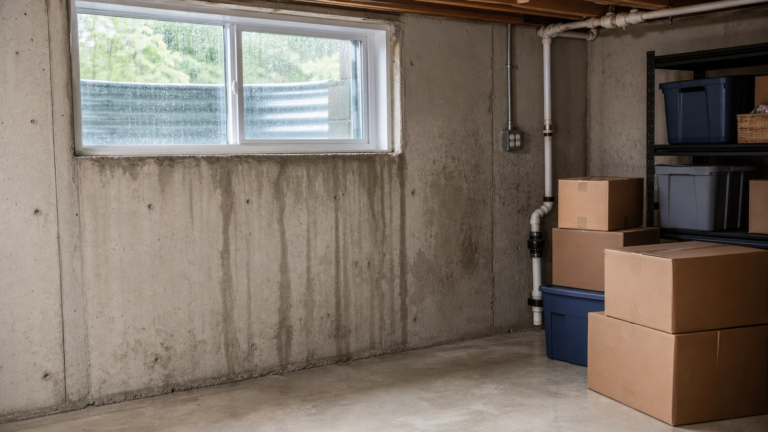
Basements have a lot of cool surfaces: walls, floors, pipes, corners, and window edges. When moist air meets those surfaces, condensation can happen lightly and repeatedly, even if it never becomes dramatic enough to look like a leak.
That repeated moisture can affect the smell of the room without leaving obvious puddles behind. Sometimes the only visible clue is a cool wall, a slightly stale corner, or a pipe that feels damp more often than expected.
Stale air with poor circulation
Some basements smell musty simply because the air does not move enough. A room with weak circulation may trap moisture and smell stale even if the actual dampness is mild. This is especially common in finished basements that stay shut for long periods, storage-heavy spaces, and lower levels with limited window opening or airflow.
The less a basement breathes, the more likely it is to hold a smell that feels damp even when the room looks okay. In many homes, that is the point where people notice the basement smells musty but still cannot see visible water anywhere.
Boxes, fabrics, and stored materials
Cardboard, paper, luggage, rugs, blankets, and stored clothing absorb moisture and odor quickly. In some basements, the room itself is only slightly humid, but the materials inside it amplify the smell.
This is why a basement can smell mustier near storage walls, fabric bins, or stacked boxes than in the middle of the room. The items are acting like sponges for the room moisture pattern.
Cool walls and low-ventilation corners
Corners behind shelving, wall sections behind stored furniture, and areas with weak airflow often reveal the real pattern first. These are the places where air gets trapped, surfaces stay cool, and drying becomes less effective.
Even if the open center of the basement looks fine, these hidden zones may be where the musty smell really begins.
Myth vs Reality
| Myth | Reality |
|---|---|
| If the floor is dry, the basement is dry | Air humidity and hidden materials can still hold enough moisture to create odor |
| A musty smell always means a visible leak | Many basements smell stale because of circulation, condensation, or trapped humidity |
| It is only an odor problem | Smell is often the first clue that the room is drifting toward a real moisture issue |
Why smell can show up before visible dampness
People often expect moisture problems to look obvious before they matter. In reality, smell often appears earlier.
That happens because air quality changes and material odor changes do not require large amounts of visible water. A slightly humid basement can still create stale air. A cool wall can still hold just enough moisture to affect the smell nearby. A box or blanket can still absorb dampness long before it looks visibly damaged.
This is why a basement smell should not be dismissed just because the floor is dry and the wall paint looks mostly normal. Smell is often the first layer of evidence, not the last.
Investigation Notes
What homeowners often miss: the strongest clue is often not the center of the room. It is the cooler corner, the packed shelf, the damp-feeling textile, or the smell that gets worse after weather changes.
What to check first in a dry basement
Start with the places most likely to reveal hidden moisture.
Check the basement after rain or humid weather
If the smell gets noticeably stronger when the weather turns damp, that is a strong clue that moisture in the air is part of the issue.
Look at windows and pipes
Do windows fog or collect moisture? Do pipes feel damp or sweat? Those are practical signs that the room is holding too much humidity.
Smell the storage areas separately
Closely packed cardboard, fabric bins, luggage, old books, and folded textiles often reveal the problem more clearly than the room air alone.
Compare the center of the room to the edges
If the smell is noticeably worse near one wall, one corner, or behind shelves, that usually tells you more than a general the whole basement smells bad impression.
Notice drying speed
If the room stays cool and damp-feeling after normal cleaning or laundry use, that is useful evidence even without visible water. If your basement also shows a broader moisture pattern, compare it with if your basement also shows a broader moisture pattern and if the basement feels damp without an obvious leak.
When a hygrometer helps
A hygrometer helps when the basement feels musty or clammy, but you want to know whether the room is actually holding more moisture than it should.
This is often the best tool when the smell changes with weather, the room feels heavy, windows or pipes condense, the basement seems different from upstairs, or you suspect humidity more than a direct wet spot.
A hygrometer does not solve the problem, but it helps confirm whether the room air is part of the issue rather than leaving you to guess.
When a moisture meter helps
A moisture meter becomes more useful when one area seems suspicious in a more specific way. This may include a cool damp-feeling wall section, one corner that smells stronger, a stain or discoloration that may be old or active, trim or baseboards that feel different from the rest, or a wall near a window or plumbing line.
A moisture meter helps compare materials, not air. So it is useful when the question becomes is this wall actually holding moisture rather than is the room too humid. That is exactly when using a wall meter in suspicious areas becomes more useful.
Common mistakes people make
- Assuming smell means visible mold must be present
- Treating the smell like just an odor issue
- Looking only for active leaks
- Packing storage tightly against walls
- Ignoring weather patterns
What can happen if you ignore it
A musty basement that looks dry can stay in that stage for a long time, but the most common outcome is not improvement. Over time, the smell may deepen, stored materials may absorb more odor, condensation may become easier to notice, and walls or trim may begin showing clearer signs.
The room may also start affecting how comfortable or usable the basement feels. What once seemed like just a smell becomes a reason people avoid storing certain items there or stop trusting the room altogether. If a basement dehumidifier may help, the most natural next step is if a basement dehumidifier may help.
Clue List
- Smell gets stronger after rain or humid weather
- One wall or corner smells worse than the rest
- Boxes or fabrics smell before surfaces look wet
- Windows or pipes condense during the same period
Basement smell checklist
| Area to check | What to notice | Why it matters |
|---|---|---|
| Air feel | Heavy, stale, or damp feeling | Suggests high humidity |
| Windows and pipes | Fogging or sweating | Signs of condensation |
| Storage items | Musty boxes or fabrics | Materials often reveal the problem first |
| Wall corners | Cooler or smellier than the rest | Hidden low-airflow dampness |
| Weather changes | Stronger smell after rain or humid days | Good clue that moisture is involved |
If your basement smells musty even when it looks dry, the most useful next step is usually not stronger fragrance. It is understanding where moisture may be hiding before the problem becomes easier to see.
Frequently asked questions
Can a basement smell musty even if there is no leak?
Yes. High humidity, condensation, stale air, and hidden low-level dampness can all create a musty smell without an obvious leak.
Why does my basement smell damp if the walls look fine?
Because smell often appears before visible wall changes. The room may still be holding extra moisture in the air or in materials.
Should I use a hygrometer or a moisture meter first?
Use a hygrometer if the whole basement feels damp. Use a moisture meter if one wall or area seems more suspicious than the room overall.
Does a musty smell always mean mold?
Not always. It often means moisture is lingering, but the smell can come from humid air, stored materials, or slow-drying surfaces too.