Best Dehumidifier for Basement: What to Look For Before Buying
If you are trying to find the best dehumidifier for basement use, the most useful place to start is not with product hype. It is with the room itself.
Quick Answer
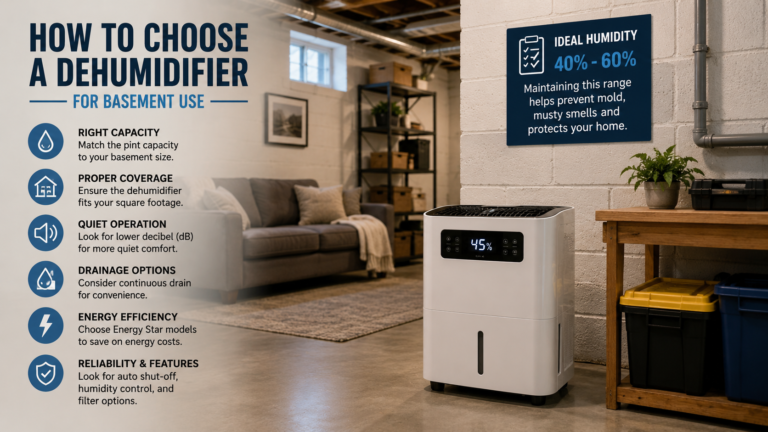
A good basement dehumidifier should match the room’s moisture load, not just its square footage. In many basements, that means looking at 35-pint or 50-pint capacity, continuous drainage, a built-in humidistat, and auto defrost for colder spaces. A practical target is usually 30% to 50% humidity, and basement humidity should generally stay below 60%.
Quick Tip
If your basement smells musty, feels clammy, or keeps making fabrics and boxes smell stale, choose based on dampness severity, not just square footage. Homeowners still deciding whether the room needs active moisture control can start with the signs your basement needs a dehumidifier.
Important
A basement dehumidifier is usually solving a different problem than a bedroom dehumidifier. Basements stay cooler, dry more slowly, and often need better drainage planning and more consistent moisture control.
Basements are rarely just another room in the house. They tend to stay cooler, collect dampness more easily, and hold stale air longer than upstairs spaces. That makes basement moisture control a more specific buying decision than a general home-comfort purchase.
This is also why a basement dehumidifier guide should not be treated as the same thing as a general home dehumidifier guide. In a bedroom or living room, buyers often focus on quiet performance and occasional seasonal use. In a basement, the real questions are different. How damp is the space? Does it need hose drainage? Is the room mostly storage or daily living space? Does the basement smell musty all the time or only in summer?
The answers to those questions matter more than brand names at this stage. If you understand the basement conditions first, the right buying criteria become much easier to identify.
That is also true when you are shopping for the best dehumidifier for a basement apartment. A basement apartment dehumidifier usually has to balance moisture control with noise, drainage convenience, and day-to-day comfort in a lived-in lower-level space.
Why basement dehumidifier buying is different from whole-home buying
A whole-home buying guide usually stays broad. It talks about room comfort, general humidity, and where a dehumidifier fits into daily life. A basement-specific guide needs to be more practical.
- cooler air
- weaker natural airflow
- more seasonal moisture swings
- storage materials that hold odor
- greater need for continuous drainage
- stronger risk of musty smell and slow drying
That means the best unit for a living room is not automatically the best unit for a basement. A basement buyer usually needs more attention on moisture load, drainage, and room behavior over time.
Signs a basement may be ready for a dehumidifier
The air feels clammy
If the basement feels heavier than the rest of the house, especially in warmer months, moisture is likely part of the problem.
The basement smells musty
A stale basement smell is one of the strongest buying signals for this category, especially if it keeps returning. If that smell is the main problem, compare this with the best dehumidifier for a musty basement. If the space still feels damp even with a unit running, why a basement can stay damp after using a dehumidifier helps narrow the next step before you choose buying criteria.
Windows or pipes collect condensation
Cool lower-level surfaces make basement humidity easier to spot.
Boxes, linens, or stored items smell stale
Stored materials often reveal a moisture problem before walls do.
The room dries slowly
If laundry areas, floors, or cool surfaces stay damp longer than expected, the basement may be holding too much moisture in the air.
Before choosing a dehumidifier
It helps to be clear about what you are trying to fix first. Is the space damp all the time, or only after rain? Do you have visible condensation, a musty smell, or moisture collecting on walls and windows? Is the room lightly humid, or does it feel wet and heavy every day? If you are not sure yet, it can help to read what size dehumidifier you may actually need before buying. If the room issue may be stale air as much as dampness, a broader dehumidifier vs air purifier comparison can help before you buy.
Those details matter because the right size, run time, and overall setup depend more on the moisture pattern than on the room label alone.
What to look for before buying
If mold prevention is the main concern, it also helps to understand what humidity level causes mold in a basement before choosing capacity and humidity controls.
Basement size
Room size still matters. A small closed storage basement and a wide finished lower level are not the same job. You want enough capacity for the space, not just the smallest unit that technically fits.
Dampness level
Two basements of the same size may need different machines. One may only feel mildly humid in summer. Another may smell musty almost every week. Dampness level should change how seriously you think about capacity and drainage.
Tank capacity
Tank size matters because it affects daily convenience. In a genuinely damp basement, a small tank can become frustrating fast.
Drainage options
This is one of the biggest basement-specific features. If the room will need regular moisture control, continuous drainage can matter more than people expect.
Noise level
Noise matters more in finished basements, offices, or guest rooms. It matters less in utility spaces, but it still affects how tolerable the machine is.
Humidity controls
A unit that can target a sensible humidity range is usually easier to live with than one that simply runs without much flexibility.
Energy use
A basement dehumidifier may run often, so operating efficiency becomes part of the real cost of ownership.
What Features Should You Look for When Buying a Basement Dehumidifier?
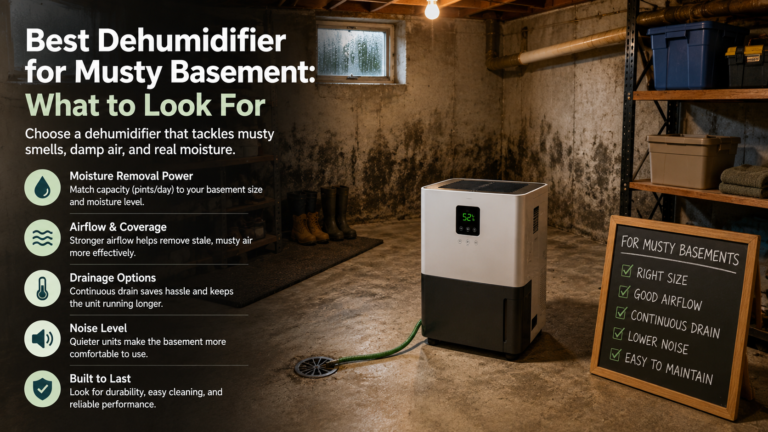
When buying a basement dehumidifier, the most important features are the ones that match real basement conditions: moisture load, colder temperatures, uneven airflow, and longer run times. That usually means paying attention to pint capacity, continuous drainage, built-in humidity control, auto defrost, noise level, filter access, and portability, rather than choosing only by price or a vague “best overall” label.
| Feature | Why it matters | What to look for | Mistake to avoid |
|---|---|---|---|
| Pint capacity | Basements often hold more moisture than upstairs rooms | A unit sized for both basement size and dampness level; 35-pint may suit lighter moisture, while 50-pint is often better for mustier or wetter basements | Buying only by square footage and ignoring dampness severity |
| Basement size | Open basements and divided layouts behave differently | Coverage that matches the actual space, including whether the basement is one room or several zones | Assuming one small unit will handle a large or broken-up basement evenly |
| Continuous drain | Regular emptying becomes annoying fast in damp basements | A hose-compatible drainage option for long-term use | Choosing a unit that is technically strong but too inconvenient to run consistently |
| Built-in humidistat | Basements need stable humidity control, not guesswork | Adjustable humidity settings that let you maintain a practical target range | Running the unit without knowing what humidity level you are aiming for |
| Auto defrost | Cooler basements can affect performance | Auto defrost or low-temperature operation for colder lower-level spaces | Assuming any dehumidifier works equally well in a cool basement |
| Noise level | Finished basements, offices, and bedrooms need quieter operation | A model suitable for how the basement is actually used | Buying a loud utility-style unit for a lived-in basement |
| Energy use | Basement units may run for long periods | Reasonable energy efficiency for ongoing use | Ignoring long runtime when comparing models |
| Filter maintenance | Dusty or storage-heavy basements can reduce performance over time | Easy-access, washable, or simple-to-maintain filters | Forgetting that neglected filters quietly reduce efficiency |
| Portability | Placement matters in basements with multiple zones | Wheels, handles, and easy repositioning if the room layout changes | Buying a bulky unit that is hard to move where it is actually needed |
Practical basement examples
Finished basement
A finished basement often needs balance. You want strong enough moisture control, but also acceptable noise, livable airflow, and a unit that fits the space.
Storage basement
Storage basements usually prioritize moisture removal and convenience over comfort. Drainage and consistent operation matter most.
Laundry basement
Laundry increases moisture load. If the space already feels damp, that extra humidity can push it further.
Basement bedroom or office
These spaces need more attention to noise and comfort. A strong machine that is unpleasant to live with may not be the best real-world fit.
If the lower level functions more like a basement apartment than a storage zone, the best choice is often the one that controls damp air without making the room harder to live in every day.
When to buy one and when to investigate deeper first
A dehumidifier usually makes sense when the basement feels damp, smells musty, dries slowly, or repeatedly shows condensation. That is the sweet spot where humidity control can make a meaningful difference.
- visible water entry
- repeated seepage
- obvious leak-related dampness
- soft or visibly wet wall materials
- unresolved structural water problems
In those cases, moisture control can still help, but it should not replace investigating the source of the dampness. If you are still in the diagnosis phase, it is worth checking basement moisture problems first. And if the basement still feels damp without obvious water, compare that with why a basement can feel damp without a visible leak.
Common buying mistakes
- Buying only by square footage
- Treating drainage like a minor feature
- Buying the cheapest option first
- Ignoring how the basement is actually used
Basement dehumidifier buying checklist
| Question | Why it matters |
|---|---|
| How large is the basement area? | Establishes baseline capacity needs |
| Does it smell musty often? | Strong sign moisture control may help |
| Is the room finished or mostly storage? | Changes noise and comfort priorities |
| Will hose drainage be useful? | Important for regular use |
| Does the basement feel damp year-round or seasonally? | Helps define how serious the moisture load is |
Basement moisture next steps
If your basement feels damp most of the time, the next step is usually to separate the symptoms from the source. Check whether the problem is mainly high humidity, poor airflow, water entry after rain, or persistent dampness in specific areas. If the room still smells stale, if your basement also smells musty, that symptom is worth tracing before you buy.
Once that is clearer, it becomes much easier to judge whether a dehumidifier is enough, whether sizing matters, or whether the issue needs a broader moisture strategy.
Next step
If you are still narrowing it down, it may help to compare the moisture pattern in your room first, then match that to the kind of dehumidifier setup that makes sense. A slightly better diagnosis usually leads to a much better buying decision.
If your basement feels damp often enough that the room changes how you use it, choosing the right type of dehumidifier is usually more about matching the space than chasing the loudest best overall claim. And if you want to know how long a basement dehumidifier should run, the next step is judging runtime by room change rather than hours alone.
Frequently asked questions
What size dehumidifier do I need for a basement?
The right size depends on both the basement’s square footage and how damp it actually is. A musty or condensation-prone basement often needs more capacity than a same-size basement that only feels slightly humid.
For a more specific sizing breakdown, see what size dehumidifier you need for a basement.
Is a 50-pint dehumidifier enough for a basement?
Often yes, especially for medium to larger basements or spaces with stronger dampness, musty smell, or repeated condensation. But whether it is enough still depends on layout, moisture load, and how the basement is used.
Should a basement dehumidifier run all day?
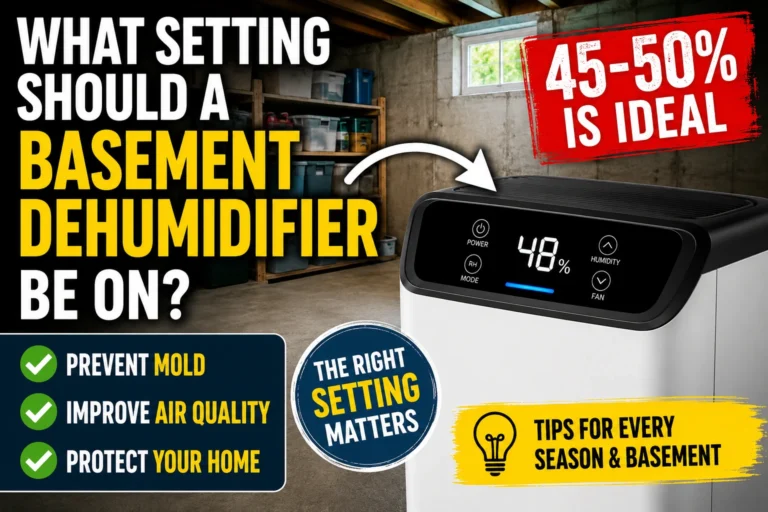
Sometimes yes, especially during humid weather or in a basement that starts out too damp. The better goal is not nonstop runtime for its own sake, but reaching and maintaining a practical humidity range. Checking what setting to use once it’s running can help you get there faster.
Is continuous drainage worth it?
In many basements, yes. If the room needs regular humidity control, continuous drainage makes the setup much easier to maintain and far more realistic for long-term use.
Do basement dehumidifiers help prevent mold?
They can help reduce the humidity conditions that support mold, especially when excess moisture in the air is part of the problem. They do not replace fixing direct water entry or damaged materials, but they are often an important part of mold prevention.
If humidity and mold risk are part of the decision, see what humidity level starts becoming risky for mold.
If placement is the next question, it helps to review where you should place a dehumidifier in a basement before setting up the unit.