Why Does My House Smell Musty?
If you are asking why does my house smell musty, the first useful thing to know is that a whole-house smell is often not truly coming from everywhere.
Quick Answer
A whole house can smell musty when moisture is building somewhere and affecting the air beyond one room. The most common reasons are damp lower levels, stale storage zones, high humidity, repeated condensation, or old moisture damage.
Quick Tip
If the whole house smells musty, do not start by treating the whole house equally. Start by finding where the smell is strongest, when it gets worse, and which room seems to feed it.
Important
This article is broader than a single-room musty smell guide. The focus here is not one bedroom or one closet. It is how a home-wide smell usually begins, spreads, and can be traced back to one or two moisture patterns.
More often, one or two parts of the home are feeding the smell into shared air, fabrics, and circulation patterns until it begins to feel like the problem belongs to the house as a whole.
That distinction matters. A room-by-room musty smell guide helps when you already know the source room. But when the entire house feels stale or damp, the better approach is to think like a tracker. Which space smells strongest? Does the smell worsen after rain, overnight, or during humid weather? Is it heavier near stairs, closets, a basement door, or a window-heavy room?
The answer is usually not random. Most whole-house musty smells come from a limited set of moisture-prone source zones.
Before you assume it is mold
A musty smell or a dark patch on a wall does not always mean active mold is the full story. Condensation, trapped moisture, poor airflow, old stains, or damp materials can create similar warning signs. If the smell is less house-wide than it first seems, it may help to compare it with a room-level musty smell pattern.
It usually makes sense to look at the wider pattern first: where the smell is strongest, when it gets worse, whether humidity stays high, and whether the surface is actually damp.
Why does my house smell musty in the first place?
A house smells musty when moisture stays in one or more spaces long enough to affect the air and surrounding materials. That moisture may be coming from a basement, a room with repeated condensation, a closet wall, or a lower-level storage area. Once the smell settles into fabrics, air movement, and enclosed spaces, it can seem as though the whole house is the problem.
- indoor humidity is elevated
- a basement or lower level smells stale
- closets hold trapped odor
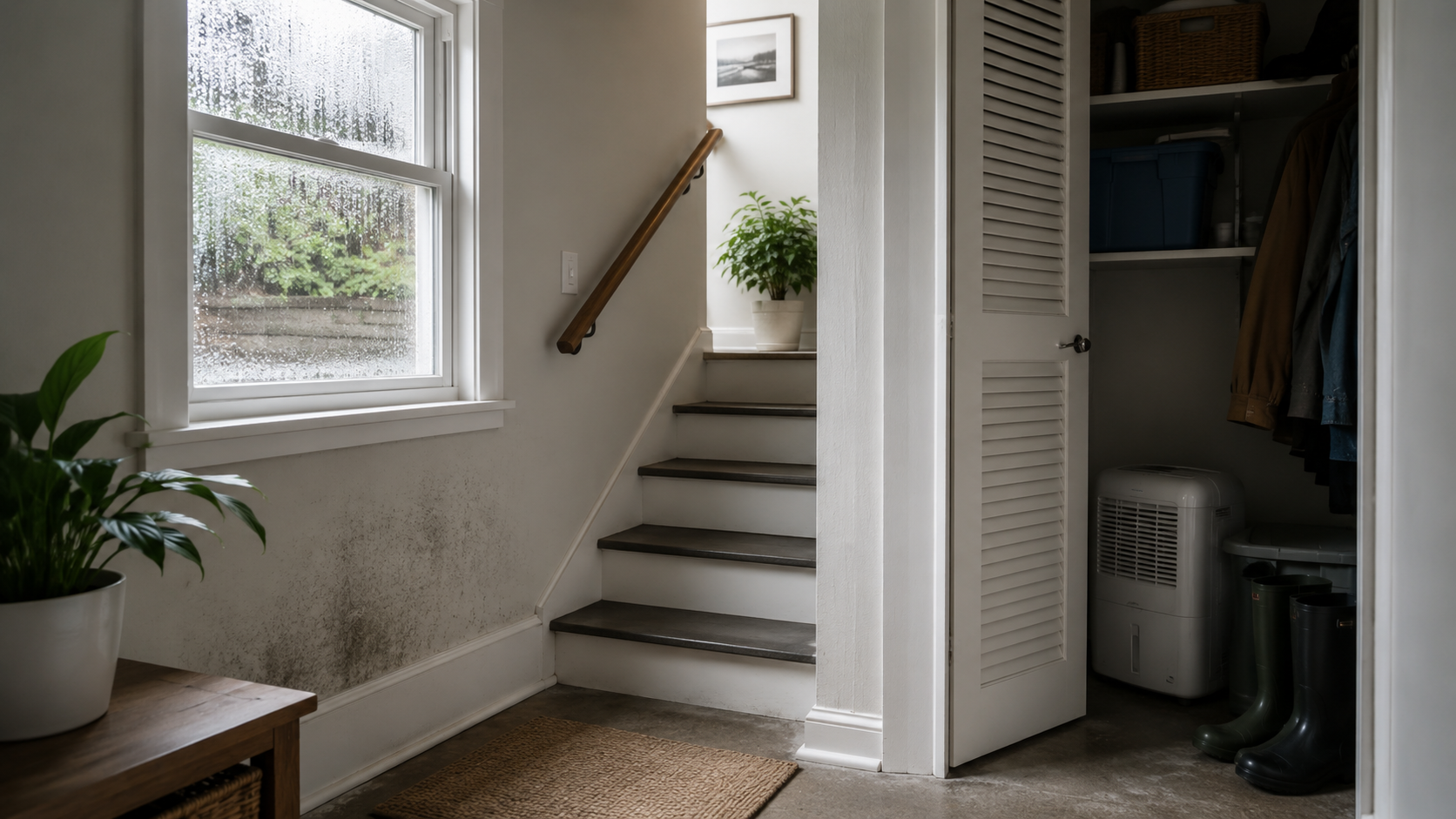
- windows and cold walls collect condensation
- drying is slow throughout the home
- older damp materials are still present somewhere
The most common source zones
Basements and lower levels
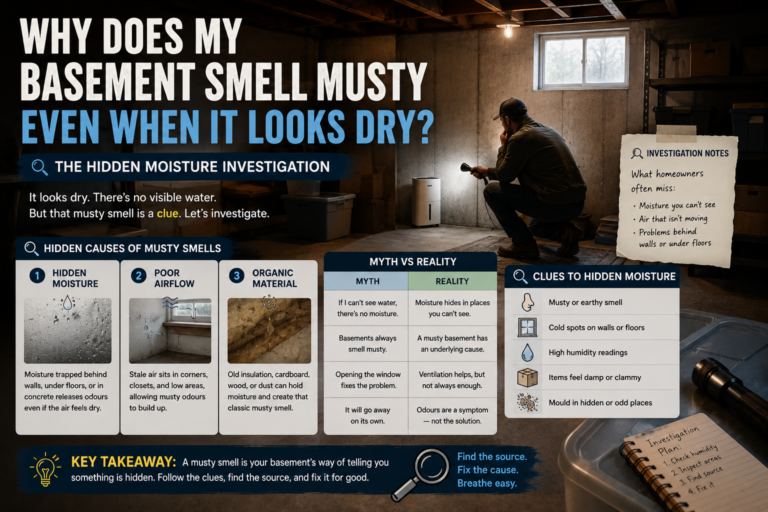
A basement is one of the most common drivers of whole-house musty smell. Even if the upper floors seem dry, a lower-level moisture pattern can influence the smell of air moving through the rest of the home.
Bedrooms and closets
Closed rooms, trapped overnight humidity, and low-airflow closets can contribute more to the overall smell than people expect, especially if fabrics absorb it. If one enclosed space stands out, compare it with when the musty smell is strongest in the closet.
Window-heavy rooms
Rooms that get repeated condensation can quietly feed stale moisture into trim, curtains, and surrounding air.
Bathrooms and damp transition zones
A bathroom that stays wet too long may not smell dramatic on its own, but it can contribute to a larger indoor moisture feel.
How to tell whether the smell is whole-house or one-zone
- Is the smell strongest in one room?
- Does it hit hardest near a staircase or lower level?
- Is it worse in the morning?
- Does it intensify after rain or humid weather?
- Is one closet or one wall more obvious than the rest?
If the answer to any of those is yes, the issue may be local but influential rather than evenly spread everywhere.
What to check first
- basement
- bedroom with morning condensation
- closet with trapped air
- exterior wall corners
- window areas
- bathroom with slow drying
Then compare those rooms to the rest of the home. If one zone clearly feels heavier, colder, or more stale, you have a better starting point than the whole house smells bad. If the smell seems strongest downstairs, that can overlap with a musty basement source.
Tools worth checking
If you are trying to understand a moisture issue, a few simple tools can make the situation easier to read. A basic hygrometer can show whether indoor humidity is consistently high. A moisture meter may help you compare surfaces and spot areas that stay damp longer than they should. In basements, even a simple habit of checking corners, windows, and stored items can reveal patterns you would otherwise miss. If the room still feels unclear, check the wider home humidity pattern as well.
Common mistakes people make
- Treating the whole home without locating the source
- Ignoring weather patterns
- Looking only for visible mold
- Assuming upper floors are the cause
What can happen if you ignore it
A whole-house musty smell can stay mildly annoying for a while, but it often means the home is holding more moisture than it should. That may later show up as stale fabrics, repeated condensation, mold-prone corners, or room-specific dampness becoming easier to see.
The earlier you find the source zone, the easier it usually is to make practical progress. If one room is clearly worse than the rest, it can help to compare that with a room-specific diagnosis before you move to equipment decisions. And if the smell gets worse after rain, the weather-linked version can narrow the source faster.
Whole-house musty smell checklist
| Check area | What to notice | Why it matters |
|---|---|---|
| Basement | Stronger odor than upstairs | Common whole-house driver |
| Bedroom windows | Condensation or stale smell | Overnight humidity clue |
| Closets | Trapped odor | Low-airflow source |
| Exterior walls | Cool musty zones | Condensation-related clue |
| Weather timing | Worse after rain or humidity | Strong moisture pattern signal |
Next step
If the smell keeps coming back, it is usually worth tracing the moisture pattern before trying to mask the symptom. In many homes, the smell improves once the air becomes drier, the source is identified, and the room stops holding dampness.
If your whole house smells musty, the fastest progress usually comes from narrowing the problem instead of treating it like a mystery everywhere at once. Find the strongest pattern, then work from there. If you do reach the point of equipment decisions, that is usually when a dehumidifier for the wider home starts to make more sense.
Frequently asked questions
Why does my whole house smell musty if only one room is damp?
Because air movement and fabrics can spread smell beyond the room where the problem started.
Is a whole-house musty smell always a basement issue?
Not always, but basements are one of the most common sources.
Can high humidity make the whole house smell stale?
Yes. Elevated indoor humidity can make multiple rooms dry more slowly and smell heavier.