What Setting Should a Basement Dehumidifier Be On?
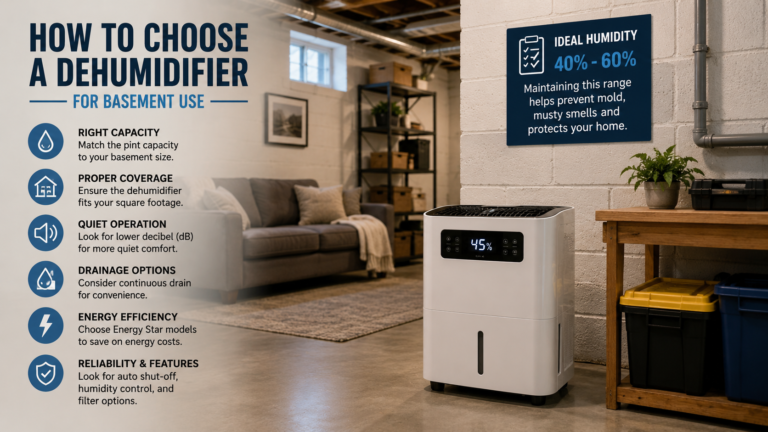
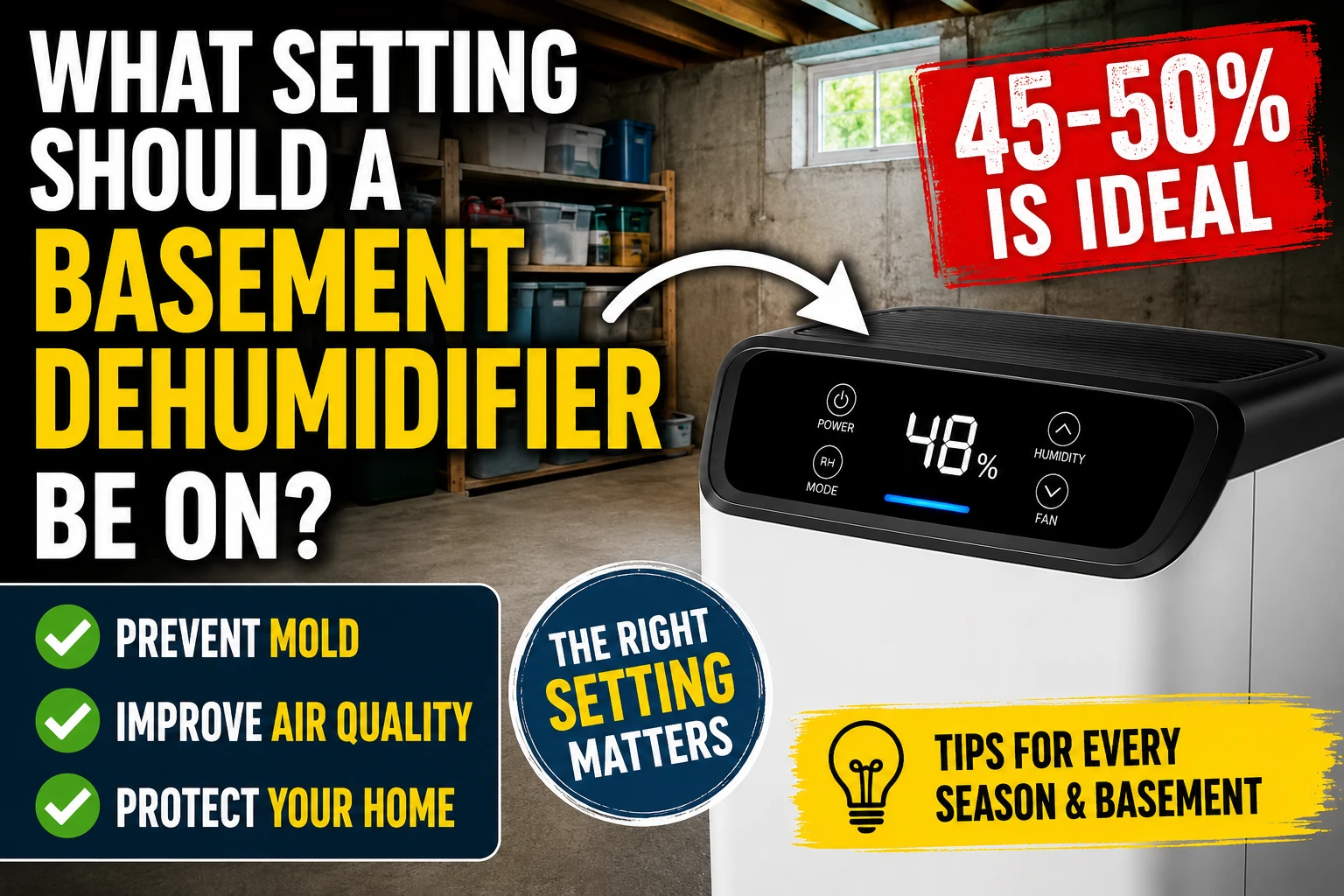
If you are wondering what setting should a basement dehumidifier be on, a practical starting point is usually 45% to 50% relative humidity. That range often balances moisture control with reasonable runtime, but it is not a perfect setting for every basement. If the room still reads high, stays musty, or feels damp, the right adjustment depends on the season, the basement itself, and whether the reading on the machine matches the actual room humidity.
Most basements are commonly managed around 45% to 50% relative humidity. Going much below 40% may make the unit run more than necessary, while readings that stay above 60% for long periods raise mold risk. The best setting depends on the basement, the season, and whether the machine display matches the actual room humidity.
- A common starting point is 45-50%.
- Avoid sustained readings above 60%.
- Compare the machine reading with a separate humidity meter.
- Continuous mode depends on the model, the drainage setup, and the basement moisture load.
What Setting Should a Basement Dehumidifier Be On in Most Basements?
Many basements work well when the machine starts in the mid-40s to around 50%. That range is often low enough to reduce damp air, stale smell, and recurring condensation without turning the dehumidifier into an energy-hungry system that never seems to stop.
It is also a practical middle ground. Some basements feel noticeably better once humidity settles under 50%, while others still need more adjustment because of cold walls, poor airflow, or a heavier moisture load. In other words, 45% to 50% is a starting point, not a universal promise.
Setting Range Comparison
| Setting | Likely result | When it may make sense |
|---|---|---|
| Below 40% | Longer runtime and a drier feel than many basements need | Only when the basement clearly stays too humid at higher settings |
| 45-50% | Balanced control for many basements | Best starting point for most spaces |
| 50-60% | May feel better than no control, but can still leave the room borderline damp | Sometimes useful as a temporary test range |
| Above 60% | Higher risk of stale air, condensation, and mold-friendly conditions | Usually a sign the current setup is not doing enough |
Why 45-50% Is a Common Starting Point
A basement dehumidifier setting in the mid-40s to around 50% often gives the room enough drying support without pushing the machine harder than necessary. It also gives you a realistic baseline before deciding whether the real problem is the number, the machine, or the room itself.
If you want the threshold logic in more detail, it helps to understand what humidity level raises mold risk in a basement before lowering the setting blindly.
Why the Display May Not Match a Separate Hygrometer
The dehumidifier display does not always reflect the exact humidity in the middle of the room. The reading can be shaped by intake position, nearby walls, colder corners, and uneven airflow around the unit.
If the number on the machine seems out of step with how the room feels, compare it with a separate humidity meter before changing the setting too aggressively.
Should You Use Continuous Mode?
Some basement dehumidifiers support continuous operation, especially when a drain hose is installed, but the manual should always be checked for your model. Continuous mode can help when a basement starts out very damp, is recovering after a humid spell, or has a heavier moisture load than usual.
In a steadier basement, automatic cycling is often enough once the room is staying near the target range.
For broader official guidance on indoor moisture and mold prevention, the EPA moisture and mold overview is a useful reference point.
Does the Ideal Setting Change by Season?
The target itself often does not need a dramatic seasonal reset. Many basements still work well around 45% to 50% year-round. What changes more often is how hard the machine must work to hold that target.
When the Setting Is Not the Real Problem
Lowering the setting does not fix an active leak, poor drainage, or a basement that keeps absorbing new moisture faster than the machine can remove it.
If one part of the basement stays damp regardless of the setting, the problem may be bigger than room humidity. Water entry, seepage, poor drainage, or colder surfaces that keep collecting moisture can all make the machine look ineffective even when it is running properly.
If the unit seems to run but the room still feels wrong, it also helps to review why a basement can stay damp even after using a dehumidifier.
The Unit May Be Too Small
If the basement is consistently humid, musty, or slow to dry, the next step may be less about lowering the percentage and more about choosing the right unit size for the basement.
The Dehumidifier May Be in the Wrong Place
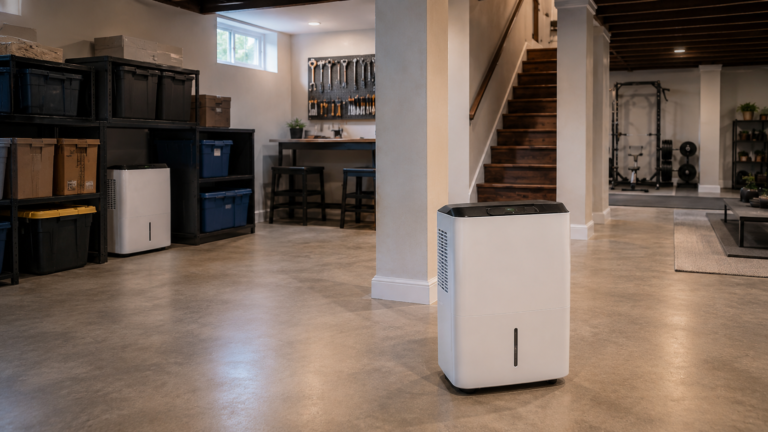
Basements rarely dry evenly, which is why where you place a basement dehumidifier matters. A poor location can make the display look acceptable while corners and storage edges still feel damp.
FAQ
What should I set my dehumidifier at in the basement?
A common starting point is 45% to 50% relative humidity, then adjust based on how the room actually behaves.
What is the best setting for a basement dehumidifier?
There is no single perfect number for every basement, but the mid-40s to around 50% is often a practical target range.
When should I use a dehumidifier in the basement?
Use one when the basement stays musty, clammy, slow to dry, or consistently humid enough to support condensation and stale air.
Is continuous mode bad for a dehumidifier?
Not necessarily, but it depends on the model and setup. Many support it, especially with drainage, but the manual should always be checked.
Why does my basement still feel damp at the right setting?
The issue may be capacity, placement, a moisture source, or uneven airflow rather than the target number alone.
Does the season affect the ideal setting?
The target may stay around 45% to 50%, but the unit often runs longer in humid months and less in drier ones.