Best Basement Humidity Level: What Should It Be?
If you are searching for the best basement humidity level, you are already asking a much better question than “why does my basement feel weird?” Many basement moisture problems become easier to manage once you stop describing them only as musty, damp, or clammy and start connecting them to a real humidity range.
That matters because basements rarely behave like the rest of the house. They are cooler, often less ventilated, and more likely to trap moisture. A humidity level that feels manageable upstairs may lead to stale air, condensation, and a musty smell downstairs. That is why the best basement humidity level is not just about comfort. It is about whether the space can stay dry enough to avoid the slow, repeating problems that make basements hard to trust for storage, living space, or even simple day-to-day use.
The good news is that basement humidity is one of the easiest moisture issues to measure. Once you know the range the room is sitting in, you can make much better decisions about airflow, moisture control, and whether a dehumidifier might actually help.
At a Glance
Best working range: around 40% to 50% relative humidity in most basements.
Main warning signs: stale smell, condensation, damp storage, or a room that feels clammy even when it looks clean.
Best use of the reading: compare the number with weather, room smell, and how quickly the basement dries.
Humidity Range Box
- 30%–50% -> Ideal
- 50%–60% -> Monitor
- 60%+ -> Risk
What the best basement humidity level usually is
For most basements, the best working humidity range is usually somewhere around 40% to 50% relative humidity, depending on season, room type, and how the space behaves.
That range is often low enough to reduce clammy air, stale smell, and repeated condensation, but not so low that the room feels harsh or unnecessarily over-dried. Some basements may feel fine slightly above or below that range in short periods, but once basement humidity starts staying too high for too long, the room usually begins to show it in other ways.
The goal is not perfection. The goal is a range where the basement feels dry enough to stay comfortable and less likely to support musty conditions.
Why basement humidity behaves differently from upstairs rooms
Basements are usually surrounded by cooler materials and get less natural airflow. Even finished basements may still hold moisture longer than the rest of the house because they are lower, darker, and slower to dry.
That means a reading that seems only mildly high upstairs may affect the basement more strongly. The room can feel heavier, fabrics can hold smell, and windows or cool surfaces can collect moisture much sooner than expected.
This is why basement humidity should be treated as its own room pattern, not just as an extension of the general house.
What different humidity levels usually mean in a basement
Range Snapshot
| Reading | What it usually means | Editorial note |
|---|---|---|
| 30%–50% | Balanced working range | Usually the most comfortable zone for a basement that stays usable |
| 50%–60% | Manageable but watch it | Often where smell, slow drying, or mild condensation start to show |
| 60%+ | Too damp for too long | Risk of musty air, stale storage, and recurring moisture signals |
Below the comfortable range
If a basement is consistently very dry, that is less common than excessive moisture, but it can still affect comfort. In most basement discussions, though, the bigger issue is not dryness. It is over-humidity.
In the healthy working range
A moderate range usually gives the basement its best chance to feel drier, smell fresher, and stay easier to use. This is where many people want to keep the space if they are actively managing basement moisture.
Getting too humid
Once the basement starts staying above a comfortable range for longer stretches, you may notice heavier air, stale smell, slower drying, or recurring condensation.
Clearly too high
If humidity is staying well above what feels manageable, especially during humid weather, the room often starts showing stronger signals such as condensation, a musty basement smell, damp cardboard, or colder surfaces staying wet longer.
Signs your basement humidity is already too high
You do not need a meter to suspect a problem, but a meter helps confirm what the room already seems to be saying. It also helps to compare those clues with signs the basement is already holding too much moisture.
- musty smell
- clammy air
- stale storage
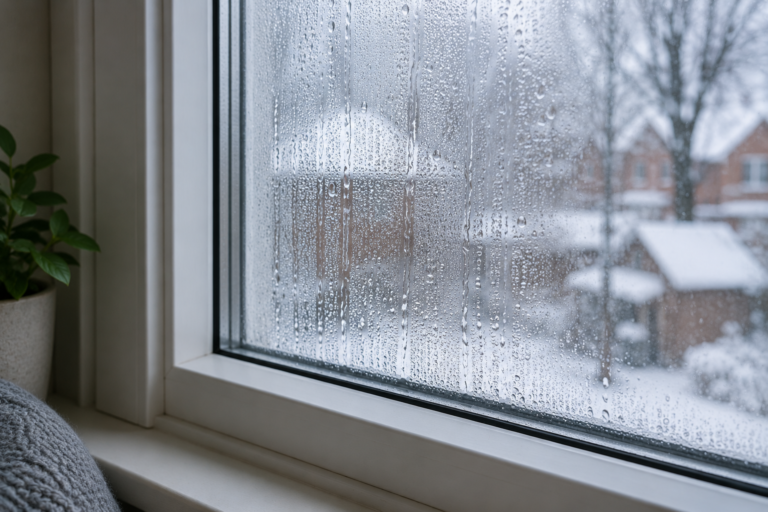
- window condensation
- damp-feeling fabrics
- slow drying after cleaning or laundry
- cooler corners that feel slightly wet or stale
If several of these are happening together, the basement is very likely holding too much moisture, regardless of whether you have measured it yet.
How to measure basement humidity properly
Use a hygrometer or humidity meter in the basement itself, not just upstairs. Placement matters. Try to keep the meter away from direct window contact, away from vents, off the floor, not pressed against a wall, and in the area you actually want to understand.
It also helps to measure during different conditions: dry weather, rainy weather, after laundry use, after the basement has stayed closed, and in morning and evening. The pattern matters more than one isolated reading. If you want how to measure the room more accurately, compare a humidity reading with suspicious wall areas too.
What to do if your basement humidity is too high
If the basement is reading too high consistently, start with practical steps: improve airflow, reduce moisture sources where possible, use a dehumidifier if the pattern is consistent, and check whether the issue is seasonal or constant.
That helps you decide whether the room needs ongoing support or a targeted response. If you are not sure how long a basement dehumidifier may need to run, compare runtime with your humidity readings before changing the target range. If the basement moisture pattern is broader, it is worth stepping back to if the basement moisture pattern is broader before you treat it as only a number problem. If the room clearly needs support, the next useful step is often choosing the right basement dehumidifier.
Common mistakes people make
- Treating basement humidity like whole-house humidity
- Measuring once and assuming the result is final
- Ignoring smell and room feel
- Waiting until condensation or damage is obvious
If the basement feels damp even without a leak, compare the reading with if the basement feels damp even without a leak and a dry-looking basement can still hold moisture before you assume the meter is the whole story.
Quick Basement Check
- ✓ Basement feels dry
- ✓ No condensation
- ✓ No musty smell
- ✓ Humidity below target
Basement humidity checklist
| Check | What to look for | Why it matters |
|---|---|---|
| Humidity reading | Around a stable moderate range | Helps define baseline |
| Musty smell | Stronger in damp periods | Sign of excess moisture |
| Window or pipe moisture | Repeated condensation | High humidity clue |
| Stored items | Stale or damp feeling | Material impact |
| Weather pattern | Worse after rain or humidity | Helps explain room behavior |
If your basement feels damp, stale, or inconsistent through the year, checking the humidity level is one of the simplest ways to understand what the room is actually doing before you try to fix it.
Frequently asked questions
What is the best basement humidity level?
For many basements, a moderate range around 40% to 50% is a practical target.
Is 60% too high in a basement?
It often can be, especially if the room already smells musty or shows condensation.
Should basement humidity be lower than upstairs?
Often yes, or at least managed more carefully, because basements react more strongly to dampness.
Do I need a humidity meter in the basement?
It helps a lot. Basement moisture is easier to manage when you can measure the pattern instead of guessing.
why is my basement still damp after using a dehumidifier